Learning platform
 en


Breaking down organised, disciplined and compact defensive units can be a difficult challenge for even the best teams, who must show high levels of technical ability, creativity and variation to disrupt their opposition and open up space to play into or through. However, having attacking players who can isolate defenders and beat them in 1v1s is a key way of unlocking these defensive structures and creating overloads inside the defending team’s shape.
In this article, FIFA Technical Study Group expert Mo Marley highlights the effectiveness of using attacking 1v1s during FIFA U-17 Women’s World Cup 2026™, which have successfully resulted in goalscoring opportunities.
Key take-aways
-
Using width to entice opposition defenders away from the defensive block or unit and create isolation.
-
Taking the defender on 1v1 using speed to accelerate, assessing their opponent’s body position and selecting the right technique to evade the defender.
-
Becoming the overload player or gaining access to space inside the opposition’s team shape.
-
Engaging additional defenders to leave team-mates unmarked.
-
Playing to team-mates who have become free or using the space to generate an attempt at goal.
Isolating the opposition full-back in wide area
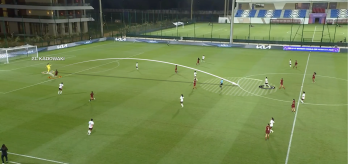
In clip 1 below, we see an example of how a wide attacking player can entice a full-back away from their defensive unit and create the opportunity for a 1v1.

As Marley explains: “Morocco winger Aya Ait Khouya Mouh stays wide, forcing New Zealand’s full-back to decide between staying connected to her centre-back, protecting the space and preventing through balls from being played, or disconnecting when the ball is played wide and covering a larger distance at speed, where she also must decelerate to arrive with control into the duel. By staying so wide, the winger gives herself space to build up speed as she approaches the defender, forcing her to decelerate early and plant her feet. In doing so, she gives the advantage to the attacking player who can now attack on the inside or outside. She uses her speed and strength to go on the outside before playing a cut-back pass towards the penalty area for her team-mate to score.”
In clip 2, we see another example of a full-back getting separated from their defensive unit. This time, the attacking player goes 1v1 on the inside, cutting onto their preferred left foot but coming in off the right side of the pitch and taking the defending player off their strong foot. Her accelerations leave other defenders flat-footed, opening space, while the movements of her team-mates commit other defenders and drag them into other areas of the pitch.
As Marley notes, “This is a brilliant team goal that starts with the goalkeeper. The movement by attacking midfielder Carolina Ferrera (15) to drop down and draw out a defender creates the opening for an inch-perfect, long pass to the centre-forward, Rocío Elaine de la Cruz (19), who brings Ferrera into play off one touch. She plays wide, creating the 1v1 opportunity for Elena Vizuete (16), who sees that the defender’s body shape is trying to guide her on the outside, but she cuts inside onto her favoured left foot. Her speed creates enough separation from the defenders to strike at goal, while her team-mates immediately follow in for any second balls or rebounds.”
Engaging extra defenders to create space
When a 1v1 is successful, the nearest defender is beaten, and often space opens up behind or around that player. This causes a problem for the next defender, who may already be occupied by an attacking player, forcing them to decide between approaching the player with the ball and leaving their player free, or staying with their player and leaving the ball-carrier unopposed. These scenarios cause further disruption to the defensive organisation. In clip 3 below, Marley highlights how a successful 1v1 forces other defenders to engage and opens space for other players.
“This is a great example from Japan, where Runa Sumiya (13) maintains width and draws out Zambia’s full-back. As she approaches the defender, she sees her plant her feet and cuts inside, immediately drawing in Zambia’s ball-side midfielder, forcing her to leave her own player free. As this player is also beaten, the centre-back is torn between protecting the space, picking up Japan’s free midfielder, or engaging Sumiya. This allows midfielder Fuki Ito (10) to make the blindside run behind the centre-back. The weight of the pass is perfect, the small disguise of her body feint slows down the recovering defender, and the touch before the pass across goal is enough to tempt the goalkeeper to the front post, opening up space behind for the low cross and finish.”
Finally, clip 4 is another example of the first defender being beaten and then a second defender being drawn out to engage. Here, Marley focuses on the technical aspects of the 1v1 that led to its ultimate success.
“The wide player, Jessica Appiah (6), recognises that her team-mate on the ball can travel, so she intentionally creates width, drawing Norway’s left back with her and opening more space in front of her team-mate on the ball. When Appiah receives the ball, she takes her first touch towards the defender, giving her the option to cut inside or outside. When she goes on the outside, the little touch of the ball out of her feet entices the defender to commit to the challenge. This is where she uses her strength and body shape to absorb the pressure before accelerating to get across the defender and come out of the duel with the ball, immediately drawing another defender in.
Summary
Attacking players use width and 1v1 technical ability to draw out opposing defenders and isolate them. This breakdown of the opponent’s defensive structure creates overloads and opens up vital central spaces within their team shape. By forcing extra defenders to commit, players can easily pick out unmarked team-mates or directly utilise the newly created space to generate an attempt on goal.
Rate your experience