Learning platform
 en
en 


In this phase of the game, intelligent movement with and without the ball is essential to progress up the pitch. Players have to be aware of their team-mates’ movement and react accordingly, always aiming to create space to receive the ball. An ability to perform under pressure is also required, which can be honed through training sessions in which players are repeatedly confronted with these high-pressure situations.
To enhance players' skill set for playing out centrally, Claire Lynne Smith, a coach at Stoke City FC, has designed a four-part training session involving eight outfield players. Players begin with an exercise focused on centre-back step-ins, before moving on to a drill that refines a central defender’s ability to play vertical balls to their central midfielders. The essence of this drill is expanded on in the third part, in which another player is added to put the team building up under more pressure. The training session culminates with a free-flowing 5v3, giving players an opportunity to put all these skills into action.
Session overview
- Part 1: Centre-back step-ins.
- Part 2: Finding the spare player.
- Part 3: Finding the spare player with enhanced pressure.
- Part 4: Building up centrally from the goalkeeper.
Key coaching points
- To play out from the back centrally, central defenders need to have confidence in their technical ability to step into midfield with the ball or play a vertical pass through to a central midfielder.
- A central midfielder should use intelligent movement when looking to receive the ball from their centre-back and make use of blindside runs.
- The timing of a midfielder's run is essential to create an open passing lane for centre-backs to play through.
- High-quality first touches and passing set the tone for the build-up's progression further up the pitch.
The video clips below illustrate this session's key concepts with real examples from high-level international youth football.
Part 1: Centre-back step-ins

This drill encourages centre-backs to identify openings and dribble past oncoming strikers. The modern centre-back holds a vital role, serving not only as a stopper but often also as a playmaker for their team. Combining with central midfielders and beating the first line of the press with bursts of pace is one method the central defender can use to progress the play up the pitch. During this exercise, players should get a feel for the situation and be eased in with a high success rate; therefore, only minimal opposition pressure is applied to start out with.
-
Set up a pitch with a length of 20m and width of 15m.
-
Distribute 8 players across the 3 different starting points, as shown in the diagram.
-
The centre-back (A) plays a one-two with the central midfielder (B), who is told by the coach to start at either the left or right mannequin.
-
The striker (C) closes down A with minimal pressure and without tackling.
-
By identifying an opening and using changes of direction to dribble into it, A beats C and drives with the ball through one of the gates.
-
Once a player has completed their turn, they then rotate clockwise to the next starting position: A moves down to C, C moves to B, and B moves to A.
-
C can now apply full defensive pressure.
-
To emulate the precision required to build up effectively in a match, it is essential that the weight and quality of the initial lay-off be perfect.
-
A first touch into the space in front of them can help the centre-back (A) gain the upper hand against the oncoming striker (C).
-
Confidence is key for defenders when playing out from the back. As a result, the centre-back (A) in this drill should not be afraid to identify openings on the pitch and step into them, bypassing the striker (C) with bursts of pace and changes of direction.
-
Changes of direction and well-timed bursts of pace are also important to help the centre-back (A) pull away from the pressing striker and reach one of the gates.
Part 2: Finding the spare player
Playing the ball directly through to a central midfielder is another way that centre-backs can progress the build-up down the middle. This drill is comprised of a set-up that pinpoints the exact skills required to execute this form of build-up and allows the players to practise them repeatedly. The coach has the option of altering the drill to either raise or lower the difficulty level.
-
Set up a pitch with a length and width of 15m.
-
Place 2 small-sized goals outside of the pitch, as shown in the diagram.
-
Distribute the players across the 5 starting points of the exercise.
-
The centre-back (B) receives the pass from the starting player (A) on the half-turn, between the two cones.
-
B then looks to pass the ball either side of the striker (C) to one of the central midfielders (D and E).
-
The striker screens between the two central cones, attempting to intercept the pass.
-
D and E make different types of run to receive the ball on the half-turn and then finish into the goal diagonally across from them.
-
C can only defend between the cones.
-
The players then rotate with their team-mates, who are waiting off the pitch.
-
C can play with no restrictions, putting B under more pressure.
-
The size of the playing area can be decreased to promote more accurate passing and movement.
-
D and E can swap positions.
-
The centre-back (B) should receive the ball on the half-turn and scan the pitch, attempting to identify central midfielders in space to play the ball to.
-
The central midfielders (D and E) should time their movement and make blindside runs to create openings.
-
When receiving a pass from the centre-back (B), the midfielders (D and E) should adjust their body position accordingly to control the ball on the half-turn, and then play forward with speed.
Part 3: Finding the spare player with enhanced pressure
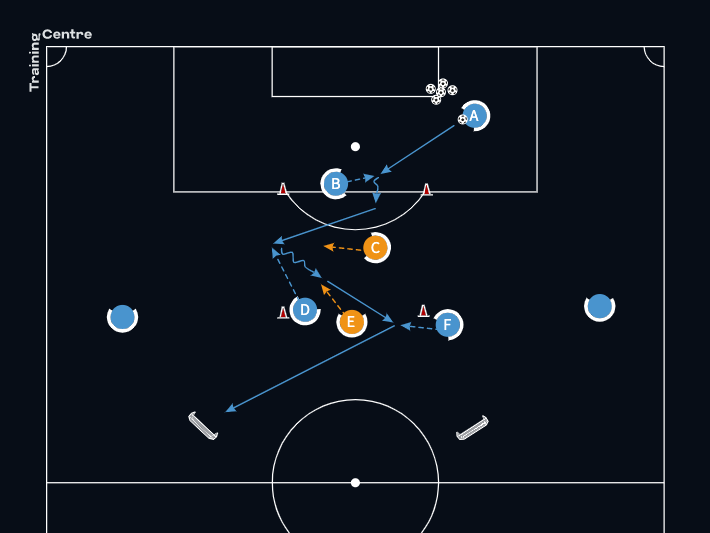
This drill is similar to the previous exercise, except now another player is added to the defending team. The two central midfielders can combine to beat the new player, whilst the original striker on the defending team still attempts to intercept the ball played by the centre-back. This exercise seeks to improve players' awareness of their team-mates' movement and enhance their ability to recognise openings, both of which are crucial when playing out centrally.
-
Set up a pitch with a length and width of 15m.
-
Place 2 small goals outside of the pitch, as shown in the diagram.
-
Distribute the players across the 6 starting points of the exercise.
-
The centre-back (B) receives the pass from the starting player (A) on the half-turn, between the two cones.
-
B then looks to pass the ball to one of the central midfielders (D and F).
-
The striker (C) attempts to intercept the pass.
-
Meanwhile, D and F make different types of run to receive the ball on the half-turn. Once in possession, they play a 2v1 against the second player (E) from the pressing team, trying to score into one of the small goals.
-
The team building up receive 1 point for scoring into a small goal.
-
The defending team receive 1 point if they win possession and then play the ball to either the coach or the player at the drill starting point.
-
The players then rotate with their team-mates, who are waiting off the pitch.
-
To avoid losing possession, the centre-back (B) must make sure that their pass to the central midfielder (D or F) is crisp and precise.
-
Being aware of other players' movement and initiating counter-runs accordingly are critical to create openings.
-
The midfielders should look to make blindside runs behind the pressing striker (C).
-
By crossing their runs, the two central midfielders (D and F) can create space to receive the ball.
-
To cut through the opposition, it is necessary to create and play through diagonal passing lanes.
Part 4: Building up centrally from the goalkeeper
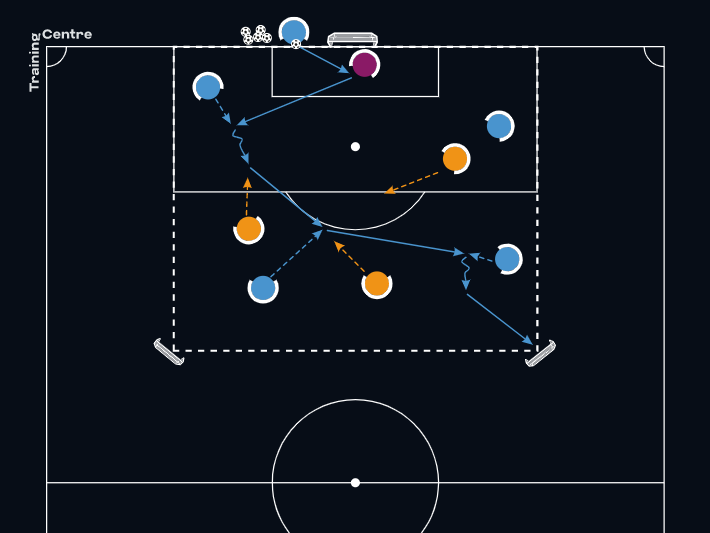
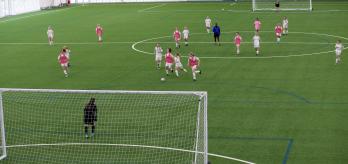
The final exercise uses elements from all the previous drills and puts them into a miniature game situation. The team playing from the full-sized goal try to build up from the back centrally, whilst being pressed by the opposition attackers. To ease in the team playing out from the full-sized goal, the drill begins as a 5v3. However, to closer resemble match situations, the difficulty is quickly increased by adding another player to the pressing side, creating a 5v4.
-
Mark out a pitch the size of 2 penalty areas, with 1 full-sized goal and 2 small-sized goals, as shown in the diagram.
-
Divide the players into 2 teams: a team of 5 (including a goalkeeper) playing from the full-sized goal and another team of 3 attackers playing from the small-sized goals, plus 1 "server" who supplies the keeper with balls.
-
5v3 starting from the goalkeeper. The pressing attackers have to wait outside of the box until the keeper passes to a centre-back.
-
From this point onwards, if a pressing attacker wins the ball, they can score.
-
Always begin from either the keeper or the coach, who occasionally gives possession to the attackers to start off the exercise.
-
Add 1 extra player to the team of 3 to heighten the pressure.
-
Have the team building out from the full-sized goal "manage" the opposition's press. To do this, the coach can initially get the team playing from the small goals to adopt a player-to-player press.
-
After some time, have the pressing team switch from a player-to-player press to a half-press and use their cover shadows to force the team in possession into an area with fewer passing options.
-
The quality of the first touch and the weight and angle of passes are aspects that players must focus on to create progressive build-up play.
-
Intelligent movement without the ball is essential to create space to receive possession.
-
Centre-backs must stretch the pitch to help create openings.
-
To prevent a flat structure and ineffective build-up, the central midfielders must avoid being level with their centre-backs.
-
Players should recognise the opposition’s press and react accordingly.
-
When the pressing team marks the team building up player-to-player, the team building up should stretch the pitch to promote switches of play and open up new space to run into.

Rate your experience