Learning platform
 en
en 


Furthermore, full-backs are deployed within the modern game to provide not only width, but also height, allowing the team in possession to create central and wide overloads by pinning the opposition full-backs. As a result of this tactic, the team in possession are susceptible to counter-attacks and being overloaded.
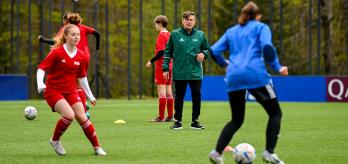
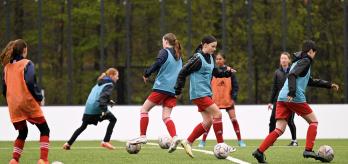
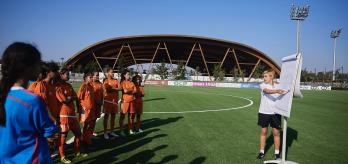
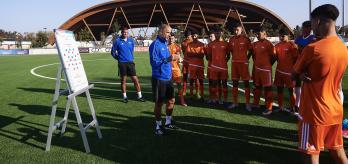
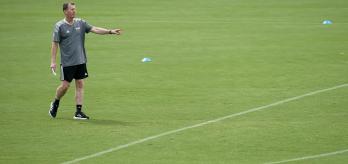
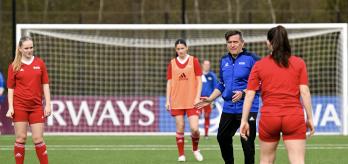
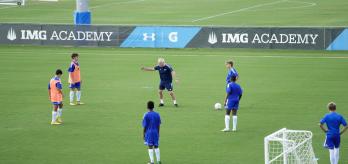
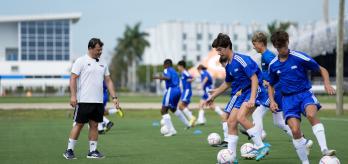
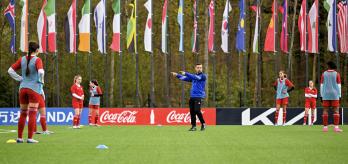
In this session, Matt Clement, FIFA’s Training Centre Manager, delivers a series of exercises to a group of young players. The drills within the session focus on overloads and how to make the most of the spare player in such scenarios. The first exercise involves a passing sequence that transitions into a 2v1 scenario in the final third. This first drill is followed by a wave game that presents a series of overload scenarios, before the session is rounded off with an exercise that features a 4v3 overload.
Session overview
Key coaching points
Each exercise in this session involves 14 players and 2 goalkeepers.
-
When working an overload, the attacking team should look to pick out and use the spare player effectively at all times.
-
Attacking players should interchange positions and make intelligent runs in order to create and exploit overload scenarios.
-
Overlaps and underlaps represent a very effective means of creating space for players on and off the ball, and can serve as decoys that cause a defender to make mistakes.
-
The timing, weight and accuracy of the final pass are critical to the successful execution of the overload scenario.
-
The attacking team should seek to create 2v1 scenarios within 4v3 and 3v2 overloads as this will allow them to use the spare player more effectively, whilst also serving to isolate the defender.
This training session was designed with a specific game situation in mind and is aimed at answering the following questions: how can an attacking team make the most of an overload situation and how can they use the spare player effectively?
Part 1: passing sequence – creating 2v1 scenarios

Our first exercise provides the attacking team with a 2v1 overload situation and aims to allow players to hone the technical skills required to execute the overload effectively and quickly. The session is underpinned by repetition in order to offer players plenty of touches of the ball and a lot of ball rolling time should be a feature so as to allow players to fully grasp the principles involved in 2v1 overloads.
-
Mark out two 30x20-metre pitches parallel to each other.
-
Place a full-size goal at the far end of both pitches.
-
Place a medium-size goal at the opposite end of each pitch, with the middle of the goal in line with the outer touchline and at a slight angle to the pitch.
-
Split the 16 players into 2 teams: 8 on the attacking team and 8 on the defending team.
-
Place a goalkeeper in each full-size goal.
-
Arrange 4 mannequins as illustrated in the image (stations A-D).
-
Position 2 attackers at each mannequin (stations A-D).
-
Position a defender approximately 10 metres in front of each full-size goal.
-
Position 3 defenders behind and to the left of the goal on the first pitch, and 3 defenders behind and to the right of the goal on the second pitch.
-
Perform the drill on one pitch at a time. Once play is concluded on the first pitch, the drill begins on the second pitch.
-
The ball starts with A.
-
A passes the ball into B's path.
-
B returns the ball into A's path.
-
A passes the ball around the outside of the relevant mannequin to C or D (depending on which pitch is being used).
-
Once this pass has been played, B moves into attack and supports C or D to create a 2v1 situation.
-
The 2 attacking players seek to combine and score.
-
The defender should advance towards C/D and B and try to prevent them from scoring.
-
The attackers are given a 6-second period in which to score so as to promote speed of play and encourage the players to take full advantage of the overload.
-
If the defender or goalkeeper wins the ball, they have to try to score in the opposite goal.
-
Once a sequence concludes, players should rotate as follows: A moves to Station B, B moves to Station C or D (depending on which pitch is being used) and C or D moves to Station A.
-
Rotate the defenders after 3 minutes.
-
Play for a total of 15 minutes.
Variation 1
-
Rather than carrying the ball directly towards goal, C/D drives inside with the ball to create space behind them for B to make an overlapping run.
-
B has to go around the mannequin at Station C before offering support in attack.
Variation 2
-
C moves backwards and away from the mannequin before passing the ball to B.
-
C then advances to support B in the 2v1 scenario.
-
Speed of play is important as overloads need to be executed quickly in order to take full advantage of the scenario.
-
The quality of passes (in terms of weight, timing and accuracy) is crucial in ensuring that overloads are executed successfully. Consideration should be given to whether a pass is played into a player's back or front foot.
-
Encourage players to play intelligent passes into the path of their intended target.
-
Attacking players should aim to time their runs to the pass and their team-mates' movement to ensure that the overload is successful.
-
Overlaps and underlaps can create decoys and provide the space the ball carrier needs to take a shot on goal.
-
Support players have to pay attention to the offside rule and give the ball carrier the option of playing a pass or taking an uncontested shot.
Part 2: wave game – using the spare player
This exercise highlights the numerous ways in which an attacking team can take advantage of an overload situation and use the spare player to great effect. By launching wave after wave of attack, players are able to focus on creative movements, such as overlaps and underlaps, as well as well-timed passes that enable a team to take full advantage of having an extra man in these real-game scenarios.
-
Mark out a 35x45-metre pitch.
-
Place a full-size goal at each end of the pitch.
-
Position a goalkeeper in each goal.
-
Split the 14 players into 2 teams: 8 on the blue team and 6 on the orange team.
-
Create the following 5 stations: Station 1 is positioned behind and to the side of the blue team's goal; stations 2 and 3 are located on either touchline in the blue team's half and approximately 5 metres from the imaginary halfway line; stations 4 and 5 are situated behind and to either side of the orange team's goal.
-
Place 1 player from the blue team at station 1.
-
Place 2 players from the blue team at station 2.
-
Place 4 players from the blue team at station 3.
-
A member of the blue team begins the drill in the centre of the pitch.
-
Place 3 players from the orange team at stations 4 and 5 apiece.
-
Once an attack finishes, the next wave sequence starts.
-
Wave 1: 1v0 – the player at station 1 passes the ball to the striker, who is positioned in the centre of the pitch.
-
The striker has a maximum of 2 touches with which to score.
-
Wave 2: 2v1 – an orange player apiece from stations 4 and 5 enters the pitch to create a 2v1 scenario and attack the opposition's goal. The blue striker becomes the defender.
-
Wave 3: 3v2 – a blue player apiece from stations 2 and 3 enters the pitch to create a 3v2 scenario. The 2 players from the orange team become the defenders.
-
Wave 4: 4v3 – an orange player apiece from stations 4 and 5 enters the pitch to create a 4v3 scenario. The 3 players from the blue team become the defenders.
-
Restart the sequence with Wave 1 at Station 1.
-
Play for 6 minutes before changing ends.
-
Play for a total of 24 minutes so as to allow each team to attack both ends twice.
-
If the defending team win the ball, they can choose from the two options laid out below:
-
-
Option 1: the player who wins the ball can attack "underloaded" (i.e. at a numerical disadvantage) and their team are awarded 2 points if they score.
-
Option 2: the player who wins the ball can bring the next wave of players into play to create an overload.
-
-
The player who wins the ball must make a quick decision about whether to attack "underloaded" or create an overload.
-
Attacking players need to make the most of the spare player and focus on the weight and accuracy of the final pass.
-
By making intelligent runs off the ball, attacking players can create space for themselves and their team-mates.
-
Players can make overlaps and underlaps to make it even harder for defenders to pick them up and block off scoring chances.
-
Attacking players can take up wide positions to stretch defenders and create space for their team-mates to attack.
-
High intensity should be adopted in all areas and scenarios in order to truly replicate real-game situations. For example, players should be quick to react in transitions.
-
Progress the session by making the players at stations 2 and 3 start closer to their own goal.
-
Regress the session by making the players at stations 2 and 3 start closer to the opposition's goal.
Part 3: 8v7 – creating 4v3 overloads
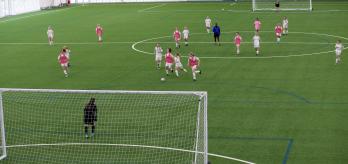
The final exercise within this session challenges the attacking team to create an effective 4v3 overload and take advantage of the spare player in a real-game scenario. By passing quickly, making over- and underlapping runs and playing with width, the attacking team are able to use the extra player to create good goalscoring chances.
-
Mark out a 40x45-metre pitch.
-
Split the pitch in half and mark out a 2-metre "free zone" that runs 1 metre either side of the imaginary halfway line.
-
Place a full-size goal at either end of the pitch.
-
Place a goalkeeper in each goal.
-
Split the 14 players into 2 teams: 7 on the blue team and 7 on the orange team.
-
A member of the orange team waits to the side of the goal, off the pitch.
-
The blue team set up in one half of the pitch with a back 4.
-
The orange team line up with 3 attackers (2 wide attackers and 1 centre-forward) in the same half as the blue team's back 4.
-
In the other half, the blue team set up with 3 attackers.
-
The orange team line up with 3 centre-backs in the same half as the blue team's 3 attackers.
-
The sequence always begins with the goalkeeper.
-
The blue team build from the back and aim for 1 of their full-backs to enter the free zone with the ball.
-
The orange team try to prevent the ball from entering the free zone.
-
Once the full-back enters the free zone, they need to carry the ball into the other half of the pitch and this sees the players in this half become active.
-
When the full-back advances into this half, the blue team attack with a 4v3 overload.
-
Once the ball is out of play, the orange team restart play and repeat the sequence.
-
Whenever the orange team's attack finishes, the player on the orange team who moved forwards to create the 4v3 overload leaves the pitch and is replaced by the spare player, who has been waiting beside the goal.
-
Only 1 player is allowed to transfer from one half to the other at a time to create the 4v3 scenario.
-
Play for a total of 15 minutes.
-
Progression 1: the defending team's wingers have to mark full-backs player-for-player and prevent them from receiving the ball.
-
Condition: the attacking team's wingers are allowed to drop into the free zone to receive the ball. The defenders are not allowed to follow them.
-
Progression 2: the 3 attacking defenders are allowed to drop off into a mid-block in order to shut off passes into the half-space.
-
Condition: the attacking team have to move the ball more quickly in order to find a free player as they can no longer play a pass straight into the centre of the pitch.
-
Condition: the wingers on the team in possession can take turns dropping into the free zone for 3 seconds at a time. The 2 remaining attackers are tasked with stretching the defenders.
-
Emphasise the need to make the most of the spare player in the final third of the pitch. How can the team create a 2v1 scenario?
-
When in possession, teams should make the pitch wider and longer to make the overload more effective.
-
In transition, attacking players need to pass and make forward movements immediately in order to take advantage of the imbalance in the opposition's defence.
-
When the wingers drop into the free zone in search of possession, they should pay attention to their body shape and look to receive the ball on the back foot so as to allow them to turn and play forwards at greater speed.
-
Players should recognise and react to their opponents' movement. If the opposing winger tracks the full-back, the team could try to play more direct and through the middle. If the opposing winger stays narrow, the attacking team can try to find a solution by playing around the winger in question and then forwards.

Rate your experience