Learning platform
 en
en 


In this session, held by U‑18 coaches Chris Moore and James Marwood, the main tactical objective is to develop combination play around the box to create chances, so each practice focuses on this theme. Players must recognise when a team utilises a high line and leaves space behind, or when they drop into a mid‑block and playing through or around them becomes the best solution. Playing quick combinations, receiving passes in the pockets, overlapping wide areas and making runs in behind are all solutions that can be used, depending on the scenario faced. The first exercise centres on general combination play, the second creates repeated opposed attacking moments around the box, and the final practice provides a technical opportunity for players to refine their connections and execution in tight attacking areas.
Session overview
Key coaching points
-
Attempt to play through pressure when the opposition adopts a medium block by finding players in the pockets and making quick combinations to draw in the defenders.
-
Recognise when a longer pass in behind the defence is on, especially if the opposition is pressing high.
-
Create 2v1 scenarios in wide positions so that overlaps or underlaps can be created, increasing the chances of crosses, cut-backs and shots from angles.
-
Try to win the ball back immediately in the opposition’s half and play fast to make the most of the opposition’s imbalance in their defensive structure.
Part 1: Possession game - 4+4 v. 4+1

This first exercise activates the players’ abilities to play through intense pressure and the passes required to do this successfully.
-
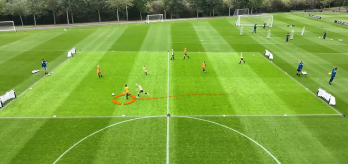
Use 1 half of a full-size pitch.
-
Mark out a 30x35m area and cut the corners.
-
10m from each corner, position a mini-goal facing the corner.
-
Split the group into 3 teams of 4 and 1 neutral player.
-
Position the blue and orange teams around the playing area.
-
Position the 4 green players and the neutral player inside the centre of the area.
-
The coaches must position themselves at either end of the area with balls.
-
The coach plays the ball to one of the blue or orange players.
-
The blue and orange teams must work together and attempt to complete 10 consecutive passes.
-
If they succeed, they must play a team-mate into the corner and pass into the mini-goal.
-
Both teams in possession score 1 point per goal.
-
The green team and neutral player must press and try to win the ball.
-
Whichever team loses the ball or runs it out of play switches with the pressing team.
-
The coach switches the neutral player, basing their decision on which player is underperforming in possession.
-
Limit the team in possession to 2 touches.
-
Remove the neutral defender.
-
Avoid making constant sideways passes away from pressure and look to either play through the press or make sudden changes of direction to throw the defending team off and create more space.
-
Keep the ball moving, and wherever it is possible, make use of quick one-twos or combinations that can eliminate pressing players.
-
Be conscious of team-mates under immediate pressure from 2 players, as this can mean another team-mate has more space elsewhere.
-
Use reverse passes to cut through pressure and disrupt the opposition’s press.
-
Players must react quickly and press immediately with good organisation after a loss of possession.
-
Communication in the press should come from covering defenders who must instruct players closer to the ball.
Part 2: Attack v. defence scenarios — 6v6
This exercise presents the players with numerous attack v. defence scenarios across the pitch. Each scenario requires decisive action and intelligent movement on and off the ball and encourages the team to play through different types of pressure.
-
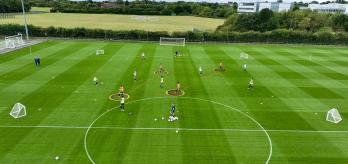
Mark out a 70x40m pitch.
-
Position a full-size goal and a goalkeeper at one end.
-
Position 4 mini goals across the pitch at the other end — 2 in the wide channels and 2 in the half spaces.
-
Mark out a halfway line.
-
Split the group into 2 teams of 6.
-
The coach stays with some balls at the same end of the pitch as the mini-goals.
-
Set up both teams in a 4-4-2 shape.
-
In a defensive shape, it should be 4-2.
-
In an offensive shape, it should be 4-2 with the wide midfielders pushed higher.
-
The exercise presents 4 different attacking scenarios, and the coach will run through these to start with.
-
After all these sequences are played, switch the teams around so they both face each attack v. defence scenario.
-
The team that earns the most points wins the game.
-
Starting from the halfway line, the blue team must make 5 unopposed, consecutive passes across the defensive line.
-
Once they complete the 5 passes, they must try to play through the opposition and create an attack.
-
The orange team must start in a mid-block position and wait for the 5 consecutive passes before trying to win the ball back.
-
If the orange team wins the ball back and secures it, they win 1 point.
-
If the blue team progresses successfully and scores in the mini-goals, they win 1 point.
-
No points are awarded should the ball go out of play.
-
The blue team starts with a high press from beyond the halfway line.
-
The orange team receives the ball deep in their half, and from the coach.
-
The orange team must make 5 consecutive passes, moving the ball from full-back to full-back.
-
Once they complete the passes, they must try to find a team-mate in behind the high line.
-
If the orange team scores, they gain 1 point.
-
If the blue team carries the ball across the halfway line, they score 1 point.
-
The orange team starts around the halfway line.
-
The blue team drops into a medium-block defensive shape in the middle of their half.
-
The coach supports the orange team and provides depth.
-
The coach starts the attack and passes to the orange team.
-
The orange team must combine to try to score a goal and earn 1 point.
-
If the blue team wins the ball, they must carry it over the halfway line to score 1 point.
-
The orange team starts from the middle of the opponents’ half.
-
The blue team defends on the edge of their penalty area.
-
The blue team’s 2 pivot players do not start the first sequence, making it a 6v4 game for the oranges.
-
The orange team must use the numerical advantage to create an attack and score.
-
Once the attack ends or a goal is scored, the second phase starts.
-
The two blue pivot players join in to make it a 6v6 game.
-
If the orange team scores a goal, they win 1 point.
-
If the blue team carries the ball over the halfway line, they score 1 point.
-
The starting position and sequence are the same as in Sequence 4, but the defending team now has six players again, defending in a 4‑2 structure.
-
Seek to play through the opposition as soon as possible when attacking against a medium block so that defenders are forced to push up, and space is created in wide areas.
-
Against a high press, look for movement in behind the high line and play passes for team-mates to run onto.
-
Use quick combinations to draw in defenders when attacking a low block. This can help team-mates find spaces and gaps in the defensive line.
-
Wide players can use space to engage full-backs, cut inside or attempt to play through via 2v1 scenarios.
Part 3: Position-specific finishing
This third exercise provides players with a series of finishing sequences. Each sequence is different but relies on well-weighted and timed passes in combination with well-timed movement off the ball.
-
Use 1 half of a full-size pitch.
-
Position a full-size goal at one end of the pit.
-
Position a goalkeeper in the goal.
-
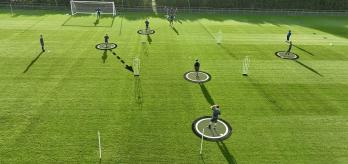
Create a defensive line by positioning 6 mannequins across the pitch that are 10m from the edge of the penalty area.
-
Create a second defensive line with 3 more mannequins that are 10m apart and 10m from the first defensive line.
-
Position 2 players on each of the wide mannequins (Stations D and E).
-
Position a player between the 2 central mannequins (Station C) on the first defensive line.
-
Position a player on each of the wide mannequins (Stations A and B) on the second defensive line.
-
The remaining players must wait behind one of these mannequins.
-
The players will complete a series of sequences and finishes.
-
Once one sequence ends, the next begins immediately.
-
Rotate the players after each set so that they spend time in each role.
-
Alternate passing directions. If the pass goes from Station A to Station B, it must reverse in the next set.
-
Vice versa for the overlaps and crossing situations.
-
The 8 receives the ball, takes a touch, and then passes to the 9.
-
The 9 returns the ball to the 8.
-
The 8 plays a through ball into the run of the 10.
-
The 10 takes a touch beyond the defensive line and finishes on goal.
-
The 8 drives with the ball towards the central mannequin closest to them.
-
They make a 1-2 around the mannequin with the 9.
-
Once they get beyond the mannequin, they must shoot.
-
The coach plays a pass out wide to the player on the wing.
-
The receiver can either drop deep to receive or stay close to the mannequin.
-
If the player receives the ball wide, his team-mate must make an overlap.
-
The player passes to the overlapping player, who must make a cross.
-
The 8,9, and 10 must make a run into the penalty area and try to score.
-
If the receiver stays close to the mannequin, he must receive and play through or around the mannequin for his team-mate, who is making an overlap.
-
The overlapping player crosses for the 3 players waiting inside the penalty area.
-
Option 1 — The coach plays a direct pass between the mannequins into one of the attackers, who must try to score.
-
Option 2 - A cross is played from the right side, and 2 of the players who attacked the previous cross must now defend the cross.
-
Focus on the precision and timing of the actions so that each finishing action can be done efficiently.
-
Passes must be firm and well-weighted so that the finisher can receive the ball with little adjustment required to get power and precision on their strike.
-
Timing between the passer and receiver is key, and players must release the ball into their team-mate’s body movements.
-
Recognise which positions team-mates take up when attacking crosses. Players must cover the front post, the back post and the penalty spot.
-
Good body orientation can determine where a player receives the ball. Signals must be sent to passing players on where the ball is required.
Part 4: 6v6 small-sided game
The session ends with a small-sided game that gives the players the opportunity to put into practice all the attacking sequences, movements and finishes that they have covered thus far.
-
Use 1 half of a full-size pitch.
-
Position a full-size goal at either end of the pitch.
-
Position a goalkeeper inside each goal.
-
Narrow the pitch so it is 35m in width.
-
Split the group into 2 teams of 6.
-
Set up each team in a 4-2 structure.
-
Each team must try to attack when in possession and defend when out of it.
-
If a goal is scored or the ball goes out for a corner, the game restarts with the goalkeeper at the opposite end.
-
Goalkeepers have 5 seconds to restart the game, otherwise the other team get to take the restart.
-
Recognise when to play a team-mate in behind against a high line or play through the middle, should the opposition be in a medium block.
-
Work on quick combination play to eliminate pressing players and isolate defenders to make 2v1 scenarios.
-
Organise the pressing structure quickly so the ball can be regained fast and closer to the opposition’s goal.
-
Stick to the 4-4-2 structure so that attacks have more balance, depth and width.
Development goals
This stage represents a significant shift, as players adapt to the demands of a professional sports environment straight out of school. It is also the first age group without the guarantee of a minimum 50% game time, which can be challenging when opportunities become more competitive. Furthermore, as players are at different stages of growth and maturation, individualised technical and physical plans guide their progression.

Rate your experience