Learning platform
 en
en 


This was the first edition of the U-20 World Cup, whereby coaches could use the 'challenge card' to have an on-field decision reviewed by the match official. Teams controlled possession for an average of 48% of match time. On average, the ball was in contest for 6% of the match and out of play for 47%. Games involving New Zealand, France and South Africa recorded the highest proportion of ball-in-play time (Graphic 1), while in matches featuring Chile and Nigeria, the ball was out of play for an average of 52% of the time (Graphic 2).

In-possession phases
When in controlled possession of the ball, teams spent more time in the mid build-up (25.5%) and low build-up (22.4%) phases compared to 22.8% and 21.6% in 2023, respectively. However, teams spent less time in the progression (-1.6%) and final-third (-3.5%) phases (Graphic 4), showing how teams tended to be more efficient when looking to advance their attacks.
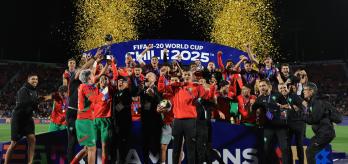
The average length of possession sequences extended from 8.1 seconds in 2023 to 8.8 seconds in 2025, demonstrating how some teams were keeping the ball for longer, with France (12.5s), Spain (12.0s) and the USA (11.8s) being the tournament’s top-ranked nations in this metric. Winners Morocco averaged 7.9 seconds per possession-sequence length, lower than the tournament average, highlighting a preference for progressing the ball more quickly.
Speed of ball progression
Nigeria, Saudi Arabia and New Caledonia stood out as the tournament’s most direct teams, favouring progressing the ball at speed using minimal passes. Spain, the USA and France preferred more patient build-ups with longer passing sequences and considered approaches to ball progressions (graphic 14).
When it came to breaking the lines of the opposition’s defence, 27% of passes were attempted line breaks, showing a clear consistency with the 27.1% attempted in 2023. Line breaks over the opposition team shape increased by 4% to 36% in 2025, while there was a 2% decrease in line breaks through (24%) and line breaks around (40%) compared to 2023.
Out-of-possession phases
When teams did not have the ball, our data shows that all block phases (low, mid, and high) increased cumulatively by 3.7% compared to 2023, with the mid-block phase increasing the most (2.3%). Teams favoured holding collectively in compact defensive structures and being more deliberate about how and when they initiated their press.
New Caledonia were the most compact team when in their block phases at this tournament, while Norway ranked second, and the winners, Morocco, were the third most compact (Graphic 11).
Defensive pressures and turnovers in the final third
The average number of direct pressures applied per 30 minutes out of possession (P30OOP) dropped from 66 in 2023 to 60 in this tournament, signalling a more strategic approach to pressing, with greater intention around when and why teams activated their press. Morocco averaged 45, while Italy (83) and Mexico (75), who ranked in the top three teams for percentage of out-of-possession time in a high press, applied the most direct pressures. Norway, who strongly favoured a low block, registered the fewest with 42. Indirect pressures P30OOP also dropped slightly from 216 to 206 per match.
Mexico were the highest-ranked side for indirect pressures (P30OOP) with 246, followed by Italy in close second with 238 and the USA in third with 237. Morocco averaged 196, while Norway only registered a mean of 171.
As can be seen in graphic 12 below, the USA combined the highest rate of final-third pressures with the highest return in forced turnovers, highlighting their aggressive, coordinated press that consistently disrupted opponents close to goal. However, champions Morocco had a completely different approach, preferring a deeper defensive strategy rather than engaging high.
Rate your experience








.variant64x64.png)



.variant348x164.png)