Learning platform
 en
en 


To exploit these channels up the flanks, attackers must provide width in the final third of the pitch with intelligent movement off the ball, read the game and anticipate passes. These actions help create more attacking options from wide areas. The goal is to have your wide player in possession of the ball in a dangerous area of the final third of the pitch, where the forwards can then attack the goal themselves or bring a team-mate into play with a cross or cut-back into the box.
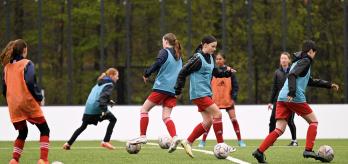
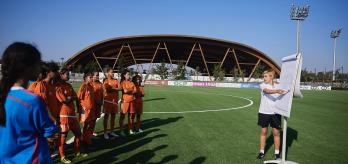
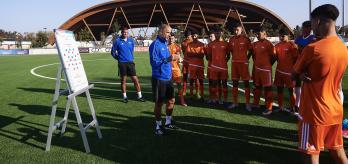
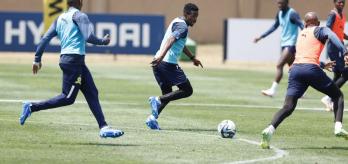
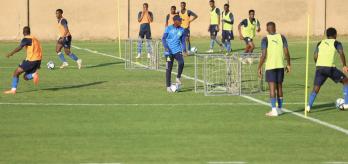
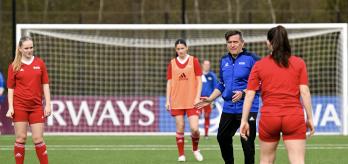
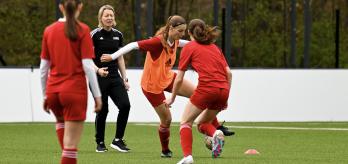
In this session, Daniel Gygax, former Swiss national team player and current youth development coach at FC Zurich, works with a group of young players to improve their wing play in possession, especially against low-block teams who keep the middle compact. A technical activation in the form of a passing drill is followed by an 8v8 possession game, a tactical 10v1 set-up and a 9v9 using different shapes and conditions. The aim of this session is to help players find solutions by playing through the wide areas when in possession and attacking against a low block.
Session overview
- Part 1: Passing circuit.
- Part 2: 8v8 possession game.
- Part 3: 10v1.
- Part 4: 9v9 in an octagon.
Key coaching points
- Advancing from possession in the centre of the pitch to attacking wide areas.
- Creating overloads on the wings and breaking the defensive line.
- Making coordinated runs into space and finding the right position in the penalty area.
- Understanding passing and crossing options (e.g. cut-backs) and recognising open space.
- Finding a well-positioned team-mate in the box to finish the cross.
This training session was designed with a specific game situation in mind: how can the team in possession make use of space out wide to be successful against teams defending in a mid or low block?
Part 1: Passing circuit

This passing circuit allows players to repeat the relevant actions multiple times. It is intended to develop individual passing and receiving techniques, along with players' understanding of when and how to position themselves to receive the ball. To translate this into a match situation, it should help a team improve their ability to use combination play on the wing to overcome the defence and progress into the final third.
-
Create a hexagon with a width of 40m and length of 50m.
-
Distribute 3 players to the positions at the top and bottom of the pitch and 2 players to the positions on the side.
-
A starts the passing pattern with a pass to B (winger).
-
B plays a short lay-off to A.
-
A plays a driven pass to C.
-
C plays a one-two with B and finishes the pattern with a pass to D.
-
D, E and F repeat the same pattern on the opposite side.
-
Instead of a one-two between C and B, B passes to D after receiving the ball from C, and D plays a one-two with C.
-
Add a second ball (position D).
-
As a group, it is important to synchronise behaviour and progress dynamically without losing speed.
-
Passes should be played with precision and correct timing.
-
Movements to receive should be timed well. The wingers (B and E) should time their movement to receive or stay in a closed position to lay off.
-
The central-midfield positions (A, C, D and F) require a good first touch, overall ball control and passing technique in order to keep the pattern dynamic.
Part 2: 8v8 possession game
This small-sided possession game challenges players' ability to exploit space laterally as a team. The shape of the pitch forces players to play diagonally from wide positions. Due to the maximum of three and later two touches, players need to adapt with faster decisions and creative positioning on the wing. Main focus is on playing the ball out to the wing from a central position and progressing higher up the pitch. This will get the opponent to move around and create opportunities for the offensive line. This exercise also improves players' spatial awareness, decision-making, combination play and passing quality.
-
Mark out a 50x40m octagon.
-
Create 2 teams with 8 players each.
-
Distribute enough balls on the side of the pitch to continue play quickly.
-
The coach starts the game with a pass from outside the pitch.
-
8v8 inside the octagon.
-
Players are limited to 3 touches.
-
10 passes without the opposition intercepting equals 1 point.
-
Variation 1: players are limited to 2 touches.
-
Variation 2: players can now use the area outside the octagon for a short period of time to offer additional passing options. 10 passes in a row with a pass outside the octagon equals 2 points.
-
Players on the team in possession without the ball should move into different spaces and offer passing options, with the aim of always being available.
-
Players in possession of the ball should scan the pitch and pass with the correct weight and quality.
-
As a team, communicate, position yourselves well and move efficiently in the given spaces to support team-mates.
Part 3: 10v1 – attacking through wing play
This drill improves a team's tactical behaviour as a whole. The coach shows the players possible patterns to attack wide areas and to create chances. The players learn to synchronise their behaviour and to understand where to move at what time. The tactical situations focus on ball circulation, creating overload situations on the wings, and crosses and cut-backs from the byline.
-
Using only the opposing half of the pitch, 10 players line up against 10 mannequins set up in a 4-4-2 formation and 1 goalkeeper.
-
The players circulate the ball and stay around their positions.
-
A maximum of 2 touches per player is allowed.
-
On the coach's signal, a central midfielder plays the ball into the space ahead of one of the wingers/ full-backs. Through different patterns of play they advance on the wing and eventually end up in the box, trying to score a goal.
-
Variation 1: players decide when to attack the wide areas and when to finish the attack.
-
Variation 2: overlapping full-backs. A winger initiates the transition from possession to attack by coming inside and calling to receive the ball. On this signal, the full-back on this side overlaps the winger and runs into an attacking position down the wing. The winger then plays the ball to the full-back, who then delivers the ball into the box.
-
Variation 3: A winger can now choose to either play directly to the overlapping full-back or involve a central midfielder, who then plays to the ball out wide to the full-back. The full-back then crosses into the box as before. This helps the players realise, there are multiple ways in which to transition into attack.
-
In this drill, players should acknowledge that there are a variety of ways to transition from possession play to an attack down the wing . Different players can initiate the transition as well as make the run into the attacking areas of the flank.
-
Communicating as a team is essential when transitioning from possession to attacking down the wing. With either movement, talking, or both, players can express their intent to initiate an attack.
-
Picking the right moment to transition from possession play to attacking play on the wing is crucial. Players need to gage the flow of the game and then commit to attacking on the wing at the right time.
-
To have an effective presence in the penalty area, every player making a run into the box must attack its different areas. Ideally, the near post, far post, central area, and the edge of the box should all be occupied by an attacking player.
-
Players in the box need to attack different areas: Near post, far post, central area, 18-yard box
Part 4: 9v9 in an octagon: creating chances through wing play
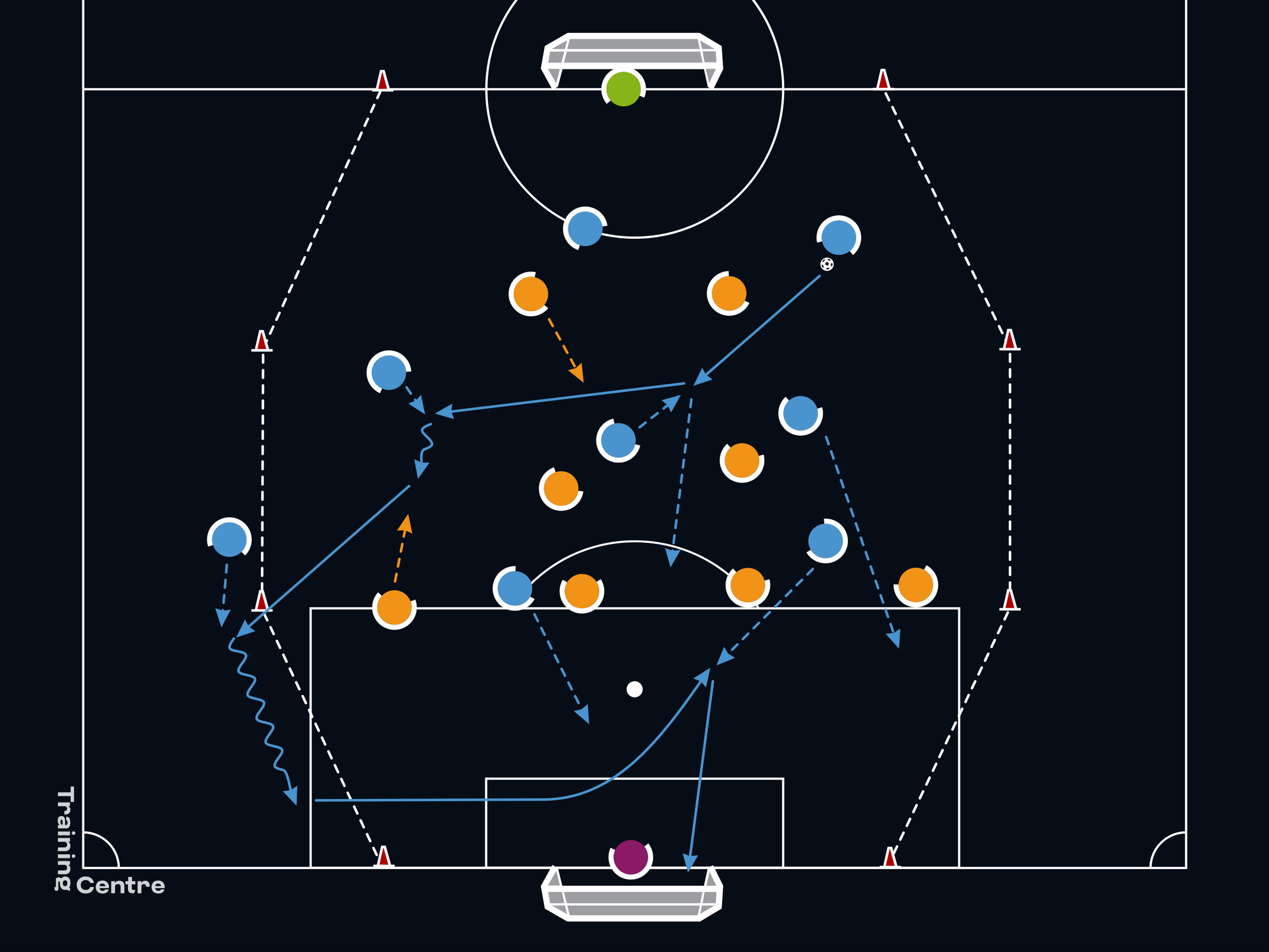
This is a 9v9 game that challenges the players' ability to make decisions on crossing and finishing within a game environment. It combines all aspects of the previous three exercises and uses them in real-match situations. The most important aspect is the movement of individual players and as a team to progress against deep defensive blocks through wing play.
-
Use the same octagonal pitch as in exercise 2.
-
14-minute halves (2-minute break).
-
2 teams with 9 players each (including goalkeepers).
-
Players engage in a regular 9v9 game on an octagon-shaped pitch.
-
The attacking team can use the cut-off corners and area outside the pitch to attack and to cross.
-
The defending team cannot enter spaces outside the octagon, making it easier for the attacking team to progress through the wide areas.
-
A goal involving the wide areas counts as two points; all other goals only count as one point.
-
The defending team can now enter spaces outside the octagon, creating a situation that is closer to a real game and increasing the difficulty of attacking successfully.
-
The attacking team should move the ball as fast as possible, increasing the space out wide and making it difficult for the opposition to organise themselves.
-
Players need to ensure their first touch after switching play facilitates the flow of play instead of slowing the attack down.
-
Moving the ball as fast as possible also entails finishing as fast as possible. A vast number of professional goals are scored with first-time finishes – this can be food for thought when finishing the chances created through wing play.
-
To increase the chances of finishing a delivery from a wide area, the attacking team needs to have a big presence in the box. This also boosts the likelihood of pouncing on a rebound.
-
Defenders must try to anticipate the winger's delivery and be aware of runs by the attackers around them.
-
Midfielders on the defending team must track back in an attempt to pick up the runners that are bursting into the penalty area.
-
Adapt the previous coaching points to this more realistic game situation.

Rate your experience