Learning platform
 en
en 


Preparation
Did you have an influence on the quality of opponents and the timing/rhythm of the game schedule for the six months prior to the Olympic tournament? If so, how?
We had a hard time finding opponents in the FIFA windows leading up to the tournament. Brazil was in a critical state in regard to the pandemic and we had difficulties both in getting teams to come to Brazil to play us and in finding countries that would authorise entry for Brazilians. Together with the cancellation of games in the Copa Sudamericana, we also had many fixtures during our preparation cancelled. In the last FIFA window running up to the Olympics, we played two friendly matches in Serbia. It was the only option we had. After not being able to enter Qatar, we played yet another game in Serbia. I personally always asked for [opposition of] the best possible standard. We lost against Cabo Verde, which was a high-level game, before playing against Serbia. In the end, due to the circumstances, we did not have much choice over the opposition we played.
Were your technical staff able to live-scout opponents prior to the Olympic Games? If not, were you able to video scout opponents?
We could not see the games live. It was not possible because of the lockdown. We wish we could have gone abroad, especially for the UEFA European Championship. We studied all our opponents at the Olympic Games to gain all the necessary information. Through the huge support of our analysts, we were able to put together a very precise report on our opposition.
Did your team lose any key players due to injury prior to the Olympic tournament? If so, how many? Who?
There were two. Gabriel Magalhães of Arsenal FC, who is an important player for us, had to have an operation during the preparation time before travelling to the Olympic Games, so we had to replace him. The other casualty was Douglas Augusto, a PAOK defensive midfielder, who suffered a muscle injury.

Olympic tournament
How is competing in the Olympic Games different from other men’s football tournaments?
It is a very particular competition. As it is a U-23 tournament, there are fewer dates for teams to come together and play in matches, so they can hardly train in the pre-Olympic stage. On top of that, it is a short competition with games every three days, which is extremely exhausting. It is almost impossible to train, meaning recovery becomes even more important. In total, we trained with the whole squad for only about a week, which was before the Olympic Games began.
Did your team lose any important players due to injury during the Olympic tournament?
Matheus Cunha suffered a muscle injury in the quarter-finals that resulted in him missing the semi-finals. He managed to play in the final, but not at 100%. As he is a player who always makes a massive effort, he needs to be physically fit to be fully in his element.
With our playing style, we take risks by pressing the opposition high up the pitch.
Can you share two or three tactical adjustments your coaching staff made during the Olympic tournament?
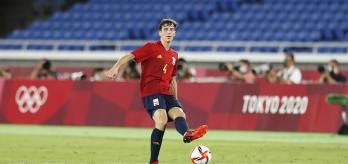
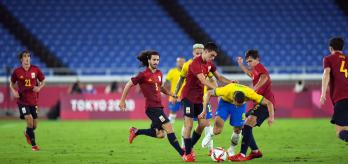
As I have already commented, we did not train a lot during the tournament. On the day before a match, we would train minimally and with light intensity, adjusting drills slightly to consider our next opponents. Plenty of analysis on our previous matches had already been carried out, helping us prepare more effectively. We adjusted after the first game against Germany, a match where we showed great attacking power. A consequence of this was teams tending to focus more on defending against us, compared to when they faced other opponents. Côte d’Ivoire played with a five-man defence, which was something new for us to play against, so adjustments were made to attack this type of rearguard – trying to find gaps and become more effective as a result. A second significant adjustment was when we faced Spain, a team that has plenty of ball possession. We had to be mentally prepared, solid in defence and even more clinical with our goalscoring opportunities. With our playing style, we take risks by pressing the opposition high up the pitch. Against Spain, with their technically advanced defenders, we needed to be cautious, as they had the ability to beat the press and exploit the space behind it.
Key players
In Dani Alves, you had a very experienced player in your squad who has won it all. How do you react if such a player gives tactical advice (throughout the game) and did this happen at some point during the tournament?
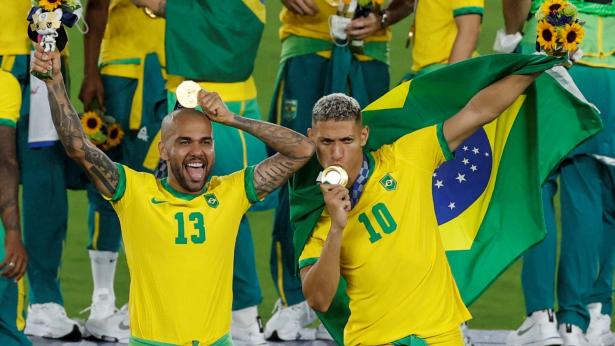
The impact he had was significant. Showing his willingness in training and the discipline in his actions are just some of the ways he positively impacts the rest of the squad. He is also a voice for the team. Before each match, we had many conversations to align our thoughts. He defended our idea of how to play on the pitch a lot.
Richarlison was a key player for Everton throughout the season. He then played in seven games at the Copa Américabefore immediately joining your squad for the Olympic tournament. Was there any doubt at one point that he could struggle to get through it and what would have been the limit for him?
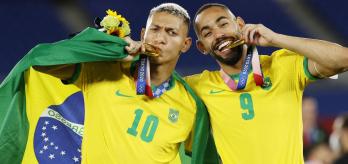
We had the concern that Everton would not release him for two tournaments, but with the loss of Pedro combined with Richarlison’s dream of playing in this tournament, we managed to get him released with great effort. Altogether it was a very exhausting tournament for him; he reached his limit. He was fundamental for the team. His game is very physical, so we deeply value the impact he made.
Conclusions
What insights did your technical staff gather from competing in the Olympic tournament?
In our analysis, we concluded it was a tournament with a very good technical and tactical level considering, one, teams were not able to prepare as much as they would have liked due to the restrictions caused by the pandemic and, two, the difficulty faced by not being able to choose all their best players, such as those who technically could have been with us in the tournament, but were selected to play for the senior national team. Furthermore, the overall standard of the tournament participants was very even, with no particularly weak sides. Supposedly stronger teams, such as Germany and Argentina, experienced many difficulties. Spain v. Brazil was, for me, the highest-quality game, consisting of players who play for clubs at the highest level.
What are your team’s areas to improve on before your next tournament?
One improvement could be made by having a larger squad to work with in the preparation time leading up to the tournament. Another would be to arrange games in preparation against teams with more experience, especially against European sides that we were unable to face this time. Anything to gain more experience.
Rate your experience